Inquiry

Contact Us Download Brochure
×
Get In Touch

We're dedicated to helping business grow and succeed. With years of industry experience and a passion for problem-solving, we offer top-level consulting service tailored to your unique needs.

instagram-thumb3

© 2026 SNJ Labs Pvt. Ltd. All Rights Reserved. | Privacy Policy

How Active Pharmaceutical Ingredients Are Manufactured
Inside the manufacturing process of Active Pharmaceutical Ingredients

Inside the Manufacturing Process of Active Pharmaceutical Ingredients

By SNJ Labs | Published on 10 August 2026 by SNJ Labs Pvt. Ltd.

When a patient takes a medicine, the tablet or capsule is usually what they notice first. What they don't see is the active molecule responsible for producing the intended therapeutic effect. Without that ingredient, the medicine simply wouldn't do the job it was designed to do.

Producing that molecule is a manufacturing discipline of its own. Active pharmaceutical ingredients manufacturing involves reaction chemistry, purification, drying, process controls, and analytical testing before a batch is considered ready for formulation. The work is often spread across multiple manufacturing operations rather than a single production step.

A commercial API production batch is built over time rather than produced in a single operation. Reaction conditions, laboratory findings, purification results, and manufacturing records continue to shape the process until the material satisfies the required specifications. Here is the practical guide to how APIs are manufactured, covering each stage from raw material selection to quality testing before they become part of a finished medicine.

Core Active Pharmaceutical Ingredients (API) Manufacturing Methods

Depending on the complexity of the drug molecule, producers rely on four main pathways to manufacture active pharmaceutical ingredients:

Chemical Synthesis

For many APIs, manufacturing starts inside a reactor rather than a laboratory bench. The target molecule is assembled gradually, with each reaction producing an intermediate that moves the process one step closer to the final compound. Depending on the chemistry involved, that sequence may run through several reaction stages before purification even begins.

Fermentation

Chemistry is not always the answer. Products such as certain antibiotics are obtained by growing carefully selected microorganisms under controlled conditions. Once fermentation is complete, the work shifts toward separating the desired compound from everything else produced during the process.

Biotechnology

Manufacturing biologics feels very different from producing conventional APIs. The molecule is generated by living cells, so the focus shifts from driving chemical reactions to maintaining the right conditions for cell growth, expression, and recovery throughout the production cycle.

Extraction

Some APIs are discovered rather than created. The starting material already contains the target compound, but separating it from everything surrounding it is rarely straightforward. Several purification stages may be needed before the material reaches pharmaceutical-grade quality.

Key API Manufacturing Stages

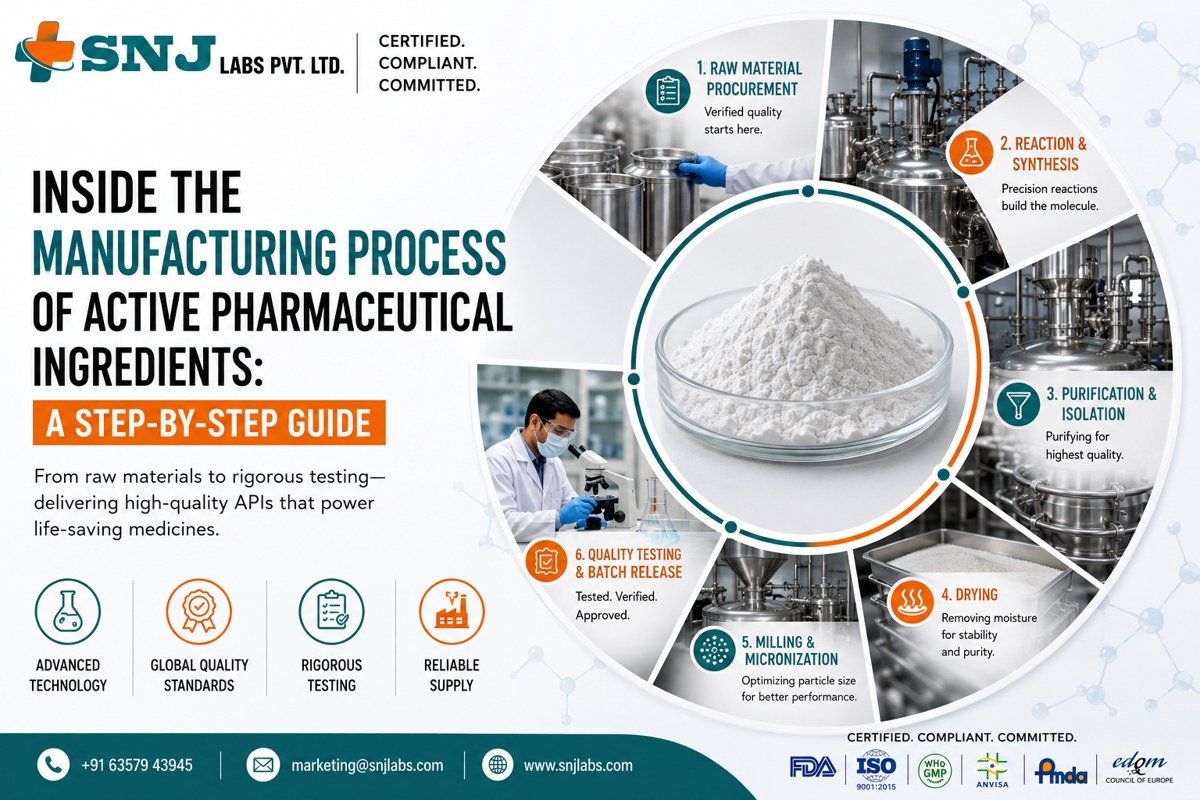
Regardless of the overarching method used, the actual API manufacturing process follows a structured series of operational steps on the factory floor:

1. Raw Material Procurement

The manufacturing team doesn't begin with production. It begins with verification. Every incoming solvent, catalyst, and raw material is sampled before it enters the plant because replacing a failed batch later is far more difficult than rejecting a shipment at the receiving stage.

2. Reaction and Synthesis

Reactor time is the core of bulk drug manufacturing. Some APIs reach the desired structure after only a handful of reactions, while others move through several intermediates before the chemistry is finally complete. That route is different for almost every molecule.

3. Purification and Isolation

Getting the molecule is only half the job. The remaining work focuses on separating it from everything that arrived with it, including unreacted materials, residual solvents, catalysts, and process-related impurities. Sometimes that takes one purification step. Sometimes it takes several.

4. Drying

The material may already look like an API by this stage, but appearance can be misleading. Moisture and residual solvents still have to be reduced before the batch moves any further.

5. Milling and Micronization

Particle size is adjusted for practical reasons rather than visual ones. A small change here can affect blending behaviour, tablet compression, or how consistently the formulation performs later.

6. Quality Testing and Batch Release

Production may finish inside the plant, but release decisions are made in the laboratory. Analytical results, manufacturing records, and batch documentation are reviewed together before the material is approved for supply.

Ensuring Quality Testing and Regulatory Clearance

A finished batch can remain inside the facility for days after manufacturing is complete. Release depends on what the laboratory finds, not on when production ends. If an unexpected result appears, the investigation starts before the material moves any further.

The laboratory review is only one part of the process. Batch records, analytical data, the Certificate of Analysis (CoA), residual solvent results, and supporting documentation are examined together before the API is cleared for supply. For products entering regulated markets, the Drug Master File (DMF) and complete batch history are typically reviewed during customer qualification or regulatory submissions.

Analytical Method Validation and Stability Assessment

A batch that meets today's specifications still has to meet them months later. That question stays with the quality control laboratory long after manufacturing has finished. The work shifts from producing the API to understanding how it behaves during storage, transport, and routine handling under different conditions.

When the Molecule Is Deliberately Stressed

Laboratories don't wait for degradation to happen naturally. They expose the API to heat, light, moisture, and different chemical conditions to see where the molecule begins to change. Those studies also confirm that analytical methods can detect those changes instead of overlooking them.

Watching the Same Batch Over Time

Some samples remain inside stability chambers for extended periods while analysts return to them at scheduled intervals. The objective isn't simply to collect data; it's to understand whether potency, impurity levels, and other quality characteristics remain within acceptable limits throughout the study.

Packaging Becomes Part of the Evaluation

The container is examined together with the API because storage conditions continue changing after manufacturing ends. Moisture ingress, oxygen exposure, and transportation can all influence product quality if the packaging system isn't suitable for the material it protects.


Selecting an Experienced API Production Company

Manufacturing an API consistently becomes more demanding as production moves from development to commercial supply. Beyond production capacity, companies often look for evidence that the API manufacturer can maintain the same quality standards across repeated manufacturing campaigns.

Some of the areas commonly reviewed during supplier qualification include:

  • Manufacturing Experience: Previous work with similar molecules, process complexity, and commercial-scale production.
  • Quality Systems: Batch documentation, deviation handling, change control, and analytical review procedures.
  • Regulatory Readiness: Availability of documents such as DMFs, CoAs, validation records, and audit support.
  • Production Capability: Reactor capacity, utility infrastructure, and the ability to accommodate changing demand.
  • Supply Continuity: Raw material sourcing, inventory planning, and contingency measures for unexpected disruptions.

Looking at these areas together often provides a clearer understanding of how an API production company operates beyond the information presented in a capability brochure.

Ending Note

Navigating the pharmaceutical manufacturing process requires a careful balance of chemical precision, engineering rigor, and strict regulatory compliance. From initial raw material qualification to complex scale-up kinetics and final impurity profiling, every step directly dictates the safety and efficacy of the end therapy.

Partnering with a reliable expert in pharmaceutical API manufacturing ensures your commercial supply chain remains consistent, fully compliant, and scalable.

Ready to secure a dependable, high-purity supply for your formulation needs? Contact SNJ Labs today to request DMF documentation, review technical specifications, or schedule a facility audit with our team.

Frequently Asked Questions

Q.1. What is the main difference between chemical synthesis and fermentation in API manufacturing?

A: Chemical synthesis builds small-molecule drugs by combining organic and inorganic raw materials through controlled chemical reactions in reactors. Fermentation uses living microorganisms (like bacteria or fungi) inside bioreactors to synthesize complex, large-molecule natural compounds, such as antibiotics or enzymes, through controlled biological feed cycles.

Q.2. How to verify if an API manufacturer meets global regulatory standards?

A: You can evaluate a supplier by reviewing their Drug Master File (DMF) filings, inspecting their cGMP compliance history with the US FDA or EMA, and requesting batch Certificates of Analysis (CoA). Schedule a facility audit with SNJ Labs to review our quality systems firsthand.

Q.3. Can SNJ Labs handle custom synthesis for proprietary active ingredients?

A: Yes. We offer end-to-end custom synthesis, scale-up engineering, and analytical method validation tailored to your specific clinical or commercial specifications. You can reach out to our technical team today to discuss your reaction chemistry and target delivery timelines.