Inquiry
Contact Us Download Brochure
By Jignesh Akbari, Director | Published on 01 October 2026 by SNJ Labs Pvt. Ltd.
When a formulation team shortlists a Sucralfate API manufacturer, the first conversation is usually about grade and price. The conversations that decide whether the relationship works come later: how the material is made, how it is tested, which documents travel with each batch, and how it reaches your site.
This guide walks through those four areas using what SNJ Labs publishes about its own facility and its Sucralfate API. It is written for formulation, procurement and regulatory teams, and the questions it raises are worth putting to any API source you are evaluating.
SNJ Labs offers Sucralfate API in multiple pharmacopoeial grades, including IP, USP, BP, EP, and JP, positioned primarily under the antacid therapeutic category. Sucralfate functions as a cytoprotective agent indicated for gastrointestinal conditions such as duodenal ulcers, gastro-esophageal reflux disease, gastritis, peptic ulcer disease, stress ulcers, and dyspepsia.
Treat these general parameters as an initial reference rather than a final technical specification. The exact grade required depends directly on your finished-product dossier, so specify your target pharmacopoeia in your initial enquiry instead of leaving the supplier to guess. If your target export market operates under a specific single pharmacopoeia, state that requirement clearly upfront.
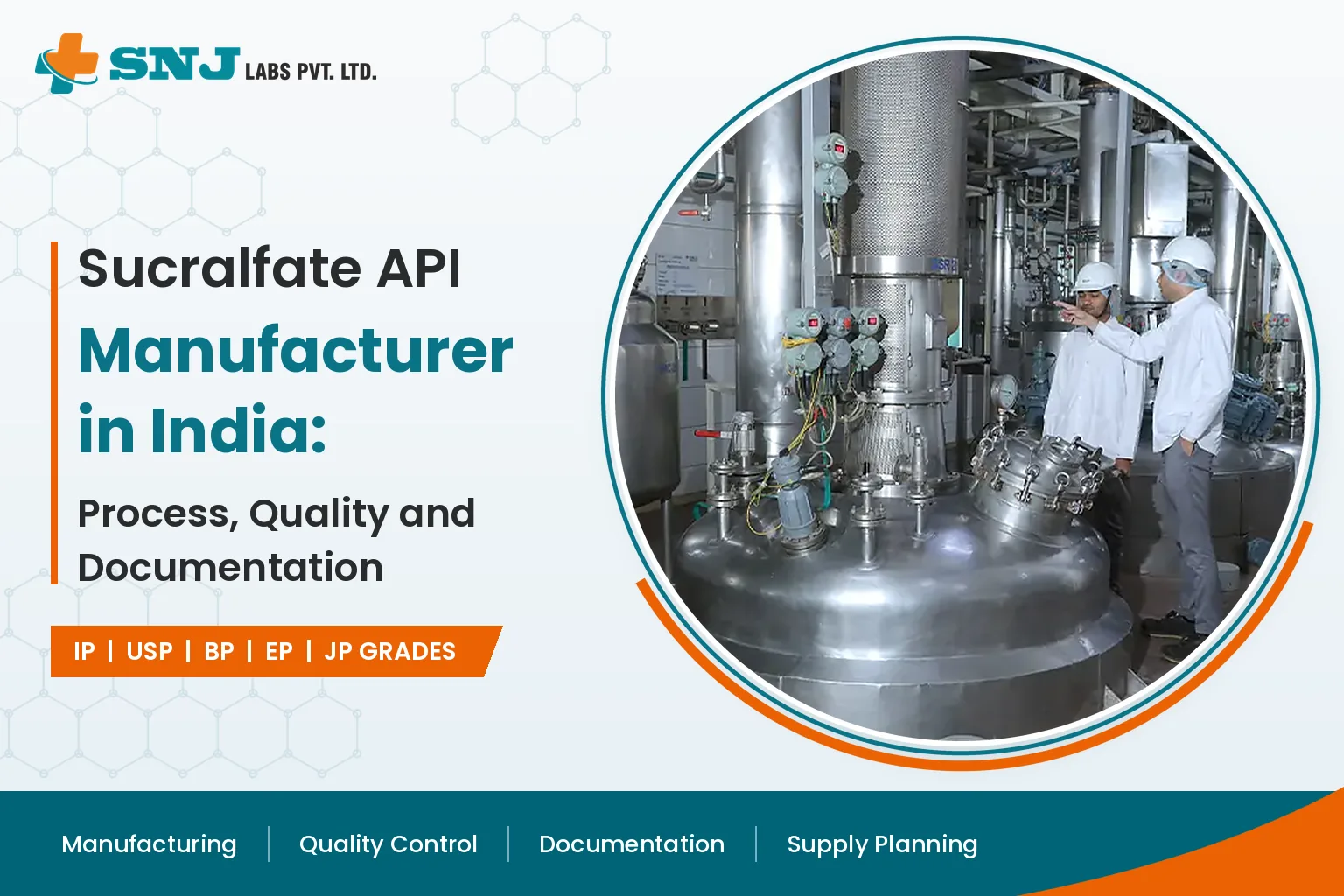
SNJ Labs describes its pharma blocks and intermediate plants as sitting on the same premises. SNJ Labs states that its facilities are designed in accordance with current Good Manufacturing Practices (cGMP), US FDA, and WHO-GMP requirements to ensure consistent manufacturing reliability across its blocks.
Two further statements are worth noting. SNJ says it can produce a wide range of APIs with backward integration of intermediate manufacturing, and that it has built its facilities to meet US-FDA, EU and WHO-cGMP requirements.
Be careful how you read these figures. They describe the whole site and not Sucralfate alone. Neither the product page nor the facility pages describe a route of synthesis for Sucralfate, and route-level detail is something to raise directly with the technical team. What you can assess from the published material is the infrastructure and controls around the process, and that is where a site visit or an audit is most useful.
Questions you must consider asking about manufacturing:
The QA and QC department page gives a fairly detailed picture. The QA/QC block is described as having wet labs, common instrumentation labs, separate HPLC, GC, AAS and stability areas, chemical storage, retain sample storage, a hot room and a separate microbiology lab. The stated purpose is to carry out intermediate, in-process and final product analysis.
The QA and QC department provides comprehensive analytical testing within its modern quality control laboratories in Rajkot, Gujarat, ensuring compliance with required pharmacopoeial standards.
Note that the instrument list on that page is written around another product, so confirm with SNJ which methods are validated for Sucralfate before you rely on a particular instrument for your release testing.
Questions to ask about quality:
SNJ states on the Sucralfate page that it supports the API with documents as required by regulators, and that it provides technical and analytical support. The QA and regulatory affairs team is described as working to ICH guidelines and handling cGMP implementation, validations, audits, DMF preparation and submission, and updates to regulatory agencies and customers.
For your own file, ask for the following and match what you receive to what the product page lists:
The warehouse page describes a separate warehouse for incoming raw material, packing material and finished products, held at predefined storage conditions, with separate storage for gaseous and hazardous material, charcoal and solvent yards.
For a buyer, that raises practical points. Ask what storage conditions apply to Sucralfate, how finished product is packed and labelled for export, and how much lead time to allow between a confirmed order and dispatch. Share your forecast, so batches can be planned around your expected demand.
Export enquiries go through the export desk listed on the site, so use the contact page to reach the right team.
The product page is titled for a manufacturer, exporter and supplier of Sucralfate API, and buyers searching for a Sucralfate API supplier or a Sucralfate API exporter will find the same page. The labels overlap, but what sits behind them differs.
SNJ’s own buyer guidance, written about Pirfenidone, offers a useful test that applies equally here. It suggests evaluating infrastructure, asking about the R&D setup, the pilot plant and backward integration, and treating vague or purely document-driven answers as a sign that you may be dealing with a trader. The same guidance recommends walking the facility, looking at how reactions are managed, how batches are scaled and how analytical labs operate, and asking how deviations are handled.
Before committing to commercial volumes, request a sample batch and test it under your own analytical and formulation conditions. SNJ’s guidance makes this point directly, noting that performance data from your own system tells you more than documentation alone.
For related reading, see SNJ Labs’ guides on how to qualify a Pirfenidone API supplier and Pirfenidone API export documents and shipping. The reasoning carries over to Sucralfate even though the product differs.
To discuss Sucralfate API for your formulation, visit the SNJ Labs contact page and share your grade, volume and documentation requirements.
Q.1. Which grades of Sucralfate API does SNJ Labs list?
A: The product page of SNJ Labs lists IP, USP, BP, EP and JP grades of sucralfate API solution.
Q.2. What documents should I ask for before ordering?
A: Ask for a batch certificate of analysis, the regulatory references listed against the product, stability data relevant to your packaging, and a description of how changes are communicated.
Q.3. How do I start an inquiry?
A: Use the contact page and include the grade, the quantity you expect to need and the markets you will supply.