Inquiry

Contact Us Download Brochure
×
Get In Touch

We're dedicated to helping business grow and succeed. With years of industry experience and a passion for problem-solving, we offer top-level consulting service tailored to your unique needs.

instagram-thumb3

© 2026 SNJ Labs Pvt. Ltd. All Rights Reserved. | Privacy Policy

Sevelamer Carbonate API Manufacturers: How to Choose a Supplier
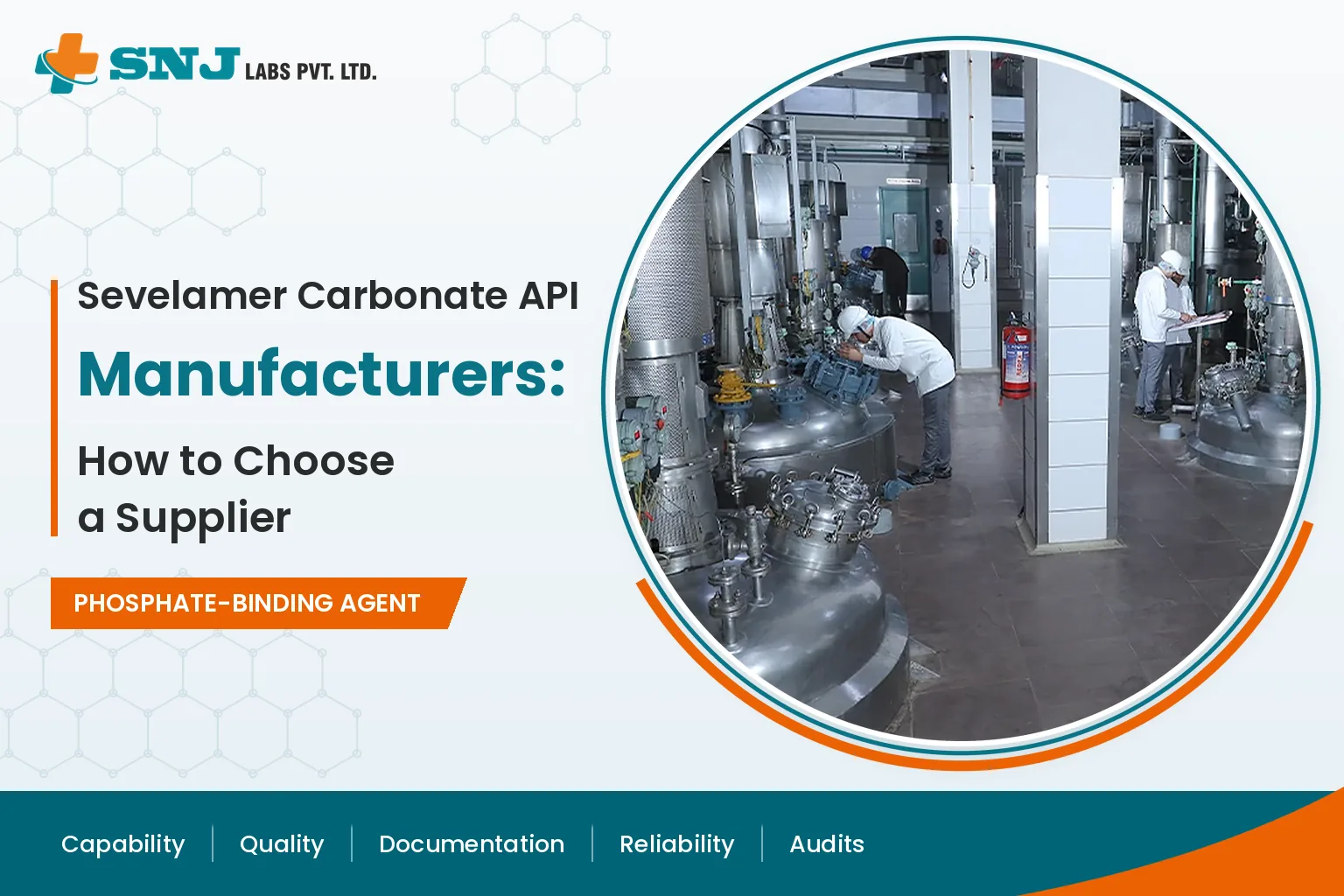
SNJ Labs banner titled Sevelamer Carbonate API Manufacturers: How to Choose a Supplier, tagged Phosphate-Binding Agent, showing operators in white coats and helmets working among stainless steel reactors in a production hall, with a footer strip reading Capability, Quality, Documentation, Reliability and Audits

Sevelamer Carbonate API Manufacturers: How to Choose a Supplier

By Jignesh Akbari, Director | Published on 19 October 2026 by SNJ Labs Pvt. Ltd.

Picture two quotations for the same ingredient: unit prices match, delivery timelines sound similar, and both vendors claim exceptional quality. On paper, separating them is nearly impossible. Six months later, one manufacturer delivers every lot on schedule while the other leaves you chasing compliance documentation and explaining production delays to your customers.

When evaluating Sevelamer Carbonate API manufacturers, your primary task is identifying these operational differences before issuing a purchase order. As a primary phosphate-binding agent formulated into medications for chronic kidney disease patients, Sevelamer Carbonate demands uncompromising supply chain security. Product consistency and delivery reliability are not optional benefits—they are fundamental requirements.

This guide outlines the precise technical parameters, regulatory checks, and auditing criteria buyers must evaluate to qualify a dependable API partner.


Capability: Can They Actually Make It?

Begin by finding out what the company really does. Some firms make an ingredient in their own facility. Others buy and resell. Many do a bit of both. Each can be legitimate, but they carry different responsibilities, so you should know which one you’re dealing with.

Ask who manufactures the material, where the work happens and which parts of the process the supplier controls directly. Ask how long they’ve been making it and whether they’d welcome a facility discussion or a walk-through call. You’re after a clear picture, not a perfect one. A supplier who can describe their own process in plain words usually understands it.

Quality: Evidence Over Claims

Everyone calls their quality high. What helps is evidence you can inspect. Ask how a lot is tested before release, who approves it and what happens to material that misses its specification. Ask whether retention samples are kept and how complaints are logged.

Then ask to see something real, such as a sample certificate of analysis along with the specification it refers to. If your market or customer needs a particular certification or approval, request the document itself and confirm that it’s current and applies to this product. Logos and website lines aren’t proof. And a supplier who says plainly what they don’t hold deserves more trust than one who hints at everything.

Documentation: What the File Should Hold

Think of documentation as the product’s paper twin. A buyer in a regulated field may be asked questions months after a delivery, and the paperwork has to be there when that happens. Items worth asking about include:

  • checksThe specification the material is tested against
  • checksA certificate of analysis with each lot
  • checksA safety data sheet
  • checksPacking, labelling and storage details
  • checksHow you’d be told if something in the process changes

Request a sample set early, since real documents show you the level of detail you’d receive on an order. If your own regulator wants more than the standard set, say so now. Discovering that at shipping stage helps nobody.

Reliability: Will the Tenth Lot Match the First?

One excellent lot is easy. Consistency is the hard part. Ask how the supplier keeps lots alike, whether a sample from a current lot can come to you for your own testing, and whether later lots can be compared with it.

On supply, ask what quantities they usually handle, how far ahead you should plan and how they’d tell you about a delay. Honest answers often include “it depends.” Be more careful with the supplier who promises everything, because there’s usually something they haven’t thought through.

Evaluating Operational Depth

Regulatory Audits and Facility Inspections

A dependable API partner welcomes technical scrutiny. Ask whether their manufacturing facility has undergone recent independent GMP audits or regulatory agency inspections, and request summary reports where permissible to confirm operational transparency.

Scale-Up and Capacity Planning

Verify whether the supplier’s reactor capacity aligns with your long-term demand forecasts. Knowing their maximum batch sizes and routine production cycle times helps prevent unexpected bottlenecks during sudden commercial scale-ups.

Change Management Protocols

Inquire about their formal notification process when minor process, equipment, or testing method changes occur. A reliable partner maintains strict change control procedures to ensure downstream product performance remains entirely unaffected.

Questions Buyers Often Forget

  1. Who is my contact for a quality problem, and how quickly do they usually respond?
  2. How are lots numbered, so a problem can be traced back?
  3. How is material packed for the journey, and how is it labelled?
  4. What happens if a lot fails your own checks?
  5. Can the supplier support the extra documents my market asks for?

None of these needs a technical background. They simply show whether the company has thought about life after the sale.

A Simple Way to Compare

Take the four areas above and score each supplier from one to five after real conversations and a sample. Don’t add up the numbers and stop there. Look for patterns. A supplier strong on three areas and open about the fourth is often a safer bet than one who claims perfection everywhere.

The method works whether your list came from searching for Sevelamer Carbonate API suppliers, Sevelamer Carbonate API exporters or a colleague’s recommendation. Keep notes on each: dates, who said what, what was promised in writing. If a question comes up later, you’ll be glad you did.

Keep the First Order Smaller Than You’d Like

Resist the urge to place a large order straight away to save time. Begin with a sample and a modest quantity, test it against the documents and watch how the supplier handles questions, packing and timing. The first order is data about the second. When it goes well, scale up in steps. To look at the product itself, the Sevelamer Carbonate API page is a sensible next stop.

Frequently Asked Questions

Q.1. What should I check first when comparing Sevelamer Carbonate API manufacturers?

A: Start with who actually makes the material, how lots are tested and released, and which documents come with each shipment.

Q.2. Is a supplier the same as a manufacturer?

A: Not always. A supplier may source the material elsewhere, so ask who makes it, where, and who answers for quality.

Q.3. Which documents should I ask for?

A: Commonly a specification, a certificate of analysis, a safety data sheet and packing and storage details. Ask what else the supplier can provide.

Talk to SNJ Labs

To discuss your requirement or ask what documentation is available, write to us through the contact page.

For domestic enquiries call +91 93289 11673 or email sales@snjlabs.com. For exports call +91 63579 43945 or email marketing@snjlabs.com. You can also send an enquiry or download our catalogue.