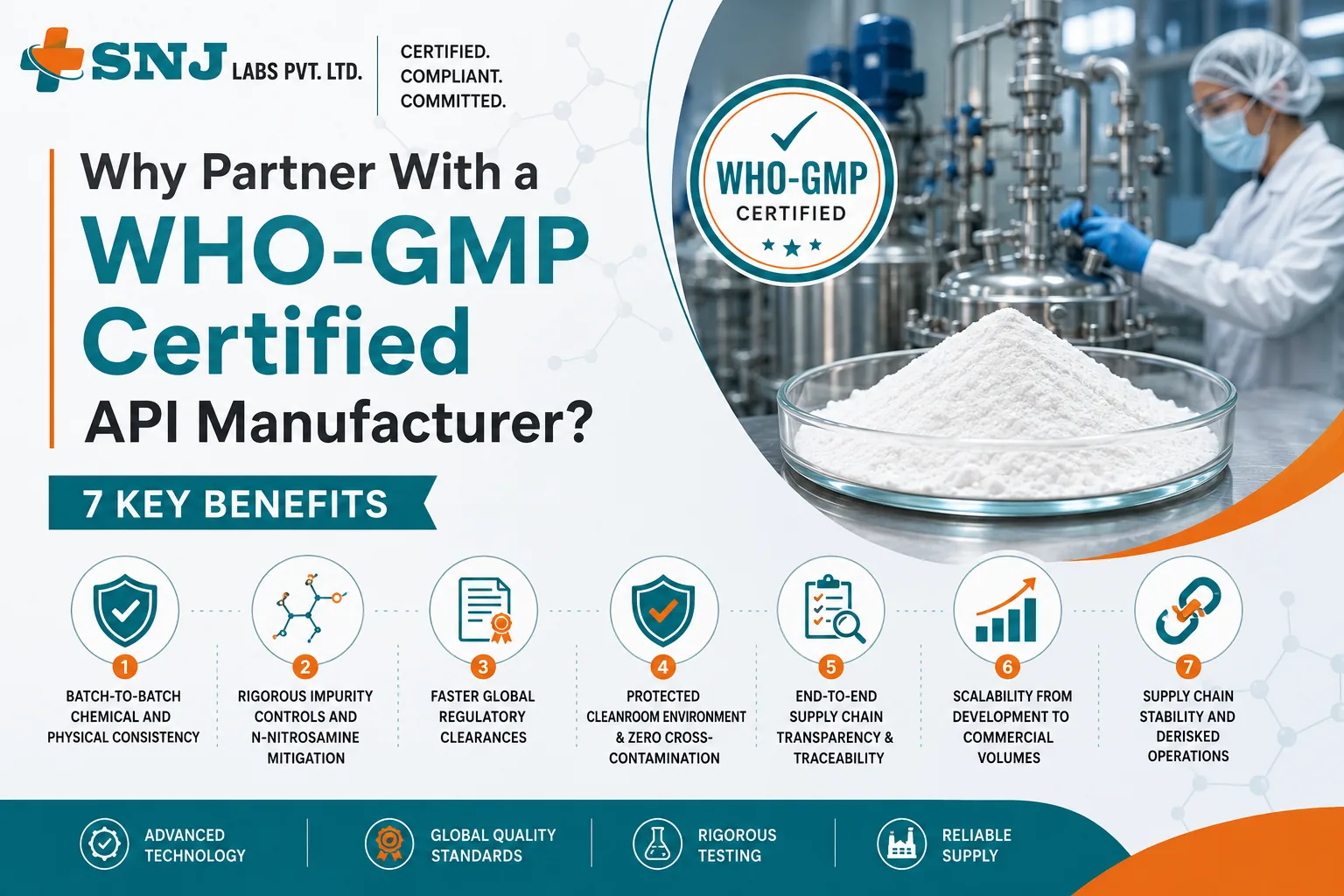
Advantages of Choosing a WHO-GMP Certified API Manufacturer
1. Batch-to-Batch Chemical and Physical Consistency
The biggest operational hazard in bulk drug sourcing is variability. A batch of raw active powder that behaves perfectly in one production run can cause capping, sticking, or dissolution failures in the next if its particle size or moisture content shifts.
A growing GMP-certified API supplier prioritizes following validated, repeatable process parameters. From reactor heating rates to crystallization cooling cycles, every step follows strict Batch Manufacturing Records (BMRs). This ensures that key physical traits such as bulk density, crystalline polymorph structure, and particle size distribution remain identical from shipment to shipment, preventing costly downtime on your automated filling lines.
2. Rigorous Impurity Controls and Nitrosamine Mitigation
Impurities are not something a quality team can simply deal with at the end of a batch. Their origin may go back to a raw material, a reaction condition, or a change in the process itself. Nitrosamines need particular attention because very small amounts can become a regulatory concern.
A qualified pharmaceutical API manufacturer builds impurity prevention directly into their synthetic chemistry routes:
Raw materials: KSMs, solvents, catalysts, and other inputs are checked before use. Supplier qualification and incoming testing help prevent an avoidable impurity from entering the process in the first place.
Reaction conditions: Temperature, pH, reaction time, and reagent quantities are watched during synthesis. A process that drifts from its established conditions can produce a different impurity profile.
Analytical screening: When trace-level testing is required, laboratories may use LC-MS/MS or GC-MS to look for nitrosamines, residual solvents, and other low-level impurities before the batch is released.
3. Faster Global Regulatory Clearances
A regulatory submission depends heavily on information generated during manufacturing. If the supporting records are incomplete or difficult to trace, questions from a health authority can take longer to resolve.
For an API manufacturing company, documents such as the Drug Master File (DMF), Certificate of Analysis (CoA), batch records, stability results, and residual solvent data form part of the technical record. Depending on the market and product, ICH Q1A and ICH Q3C information may also be required.
The regulatory team on the customer side can work with that information when preparing a dossier, answering agency questions, or supporting an existing product registration.
4. Protected Cleanroom Environment and Zero Cross-Contamination
Bulk active ingredients are sensitive to environmental factors. Airborne dust, humidity fluctuations, or minute traces of chemicals from an adjacent reactor line can ruin an entire production campaign.
Facilities specializing in WHO-GMP API manufacturing are architected to eliminate environmental exposure:
HEPA Air Filtration
Air supplied to processing rooms passes through HEPA filters to limit airborne particles and microorganisms. HVAC controls also keep temperature and humidity from drifting outside the conditions required for the material being handled.
Pressure Cascades
The pressure difference between adjoining rooms is maintained for a practical reason: air should move from the cleaner area toward the less-controlled one. This helps limit the chance of outside air entering when doors are opened.
Isolated Processing Lines
A high-potency or sensitizing compound may require its own processing area or dedicated equipment. Keeping such materials physically separated makes cleaning and cross-contact control more manageable, particularly when other APIs are produced at the same site.
5. End-to-End Supply Chain Transparency & Traceability
When a quality deviation occurs somewhere in the market, time is of the essence. You need to know the exact origin of every chemical input used in that specific product lot immediately.
An established bulk drug manufacturer maintains complete, unbroken batch traceability. Every incoming solvent, catalyst, and reagent is assigned an internal quarantine tracking number upon arrival. Quality assurance teams can trace a commercial batch back to the exact warehouse rack, the specific operator on shift, the reactor vessel used, and the individual laboratory test log within minutes.
6. Scalability From Development to Commercial Volumes
Moving an active compound from early laboratory trials to multi-ton commercial distribution is a complex chemical engineering task. Reactions that run smoothly in a 5-liter glass vessel often behave differently in a 5,000-liter industrial reactor due to changing heat transfer dynamics and mass agitation limits.
Working with a reliable contract API manufacturing partner gives you access to specialized scale-up infrastructure. Process engineers run systematic trials in kilo-labs and pilot plants to adjust thermodynamics, agitator speeds, and distillation rates. This ensures your molecule scales up smoothly from kilogram batches to commercial multi-ton volumes without dropping yield or changing its purity profile.
7. Supply Chain Stability and Derisked Operations
A supply problem rarely begins with a missed shipment. It can start much earlier with a delayed raw material, a supplier unable to meet its commitment, or a sudden change in availability. For pharmaceutical companies, those issues can eventually reach production schedules and customer deliveries.
A dependable API supplier India works with more than finished-batch capacity. The sourcing side matters too. Some manufacturers produce selected intermediates or Key Starting Materials (KSMs) internally instead of depending entirely on outside chemical suppliers. That gives them more control when a particular material becomes difficult to source or market conditions change.
The benefit is fairly practical: fewer points in the supply chain are left completely outside the manufacturer's control, which can make ongoing commercial supply easier to manage.